Monday, October 7, 2013

Mount Katahdin 2: Saddle and Summit


On Wednesday, September 18, Robert, Marc, and I set off for the summit using the Saddle Trail. While only 2.2 miles to the summit from Chimney Pond, this trail is mostly uphill and a good deal of it is over exposed rock above the treeline. Citing a bad knee, Marc set off a bit earlier than Robert and I, figuring we would catch up with him. As I ate breakfast, made lunch, and filled my day pack and water bottles I could feel my anticipation growing by the moment. However this kind of "future-thinking" was quickly put to rest by the nature of the trail...


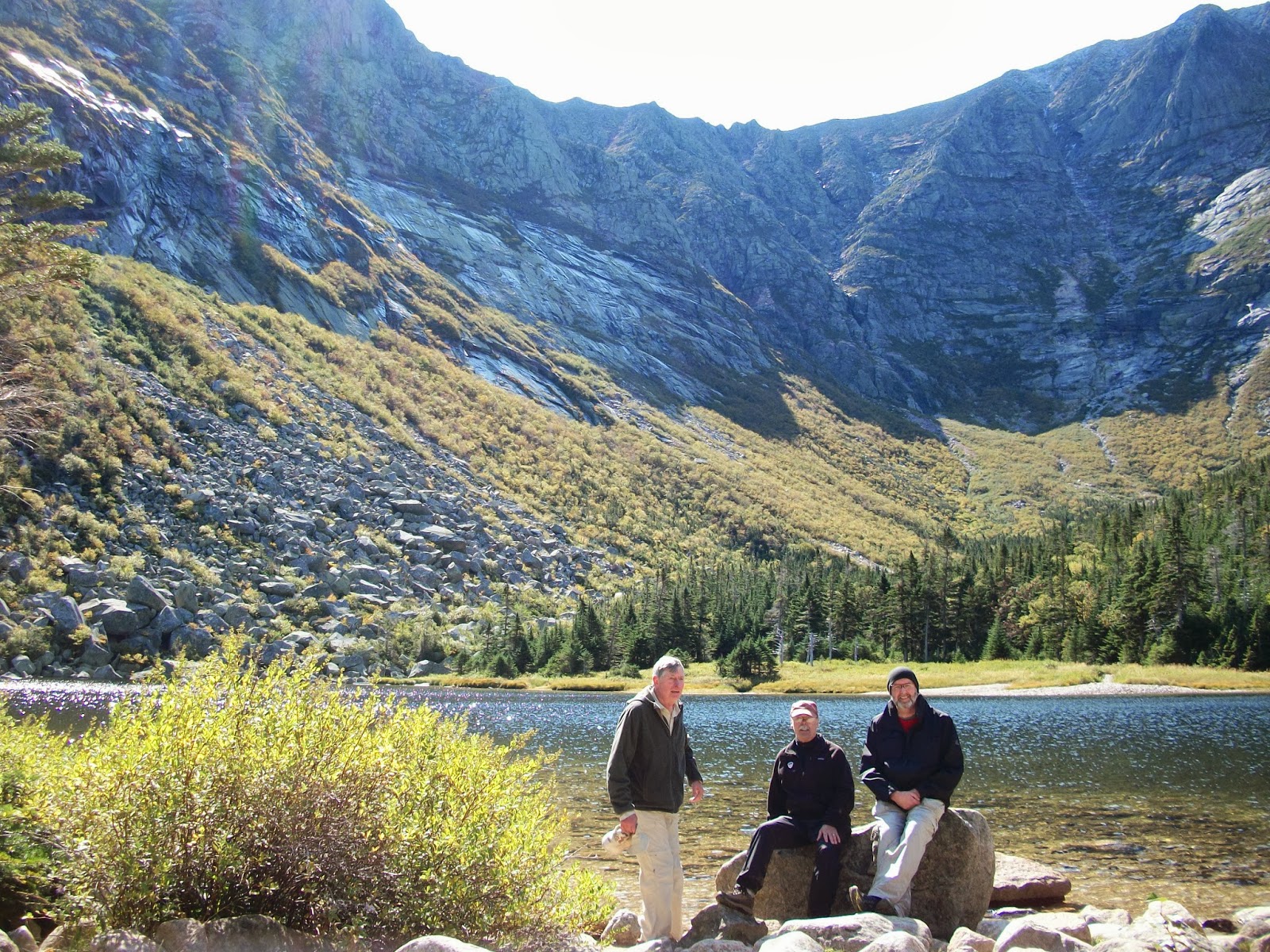
It was slow going with a good deal of scrambling and clambering over rocks. We carefully picked our way up and up and as we broke the tree-line were afforded some spectacular views. I could feel my chest swell with emotion as I turned on the trail and saw, a couple of thousand feet below, the pond from which we had ascended (and we still had about a mile and a half to go to the summit).


We climbed up the moraine that leads to the Saddle, a broad and slowly ascending table-land that leads to the peak. Staying to the right of the trail blazes for surer footing and to avoid sending a shower of stones down on those coming behind we slowly made our way toward the lip/rim of the cirque. When we reached the Saddle the wind hit us full in the face. There were gusts of between 40 and 50 miles per hour up there. Robert and I stopped to rest and put on our jackets. Marc was nowhere in sight. it seemed that his knee was not slowing him down. We still had a mile to go, so it was off along the Saddle Trail toward the summit. The Saddle Trail winds its way through scrubby gasses and piles of lichened stones. Looking around one feels on top of the world with spectacular views of mountains upon mountains and a landscape dotted with lakes and ponds. The sky comes right up to your face (but does not stop there).


Closer at hand this place feels otherworldly. The lichen is an eerie, almost phosphorescent green and it covers vast fields of pink granite stones, and amid them jagged rocks that jut straight up out of the earth.


Mount Katahdin is the northern terminus of the Appalachian Trail (southern terminus is at Springer Mountain, Georgia). One must traverse the Knife Edge and come over the South Peak before one reaches the end. I saw one silent, but clearly jubilant "through-hiker" run up and kiss the sign at the summit. 


Knife Edge


View of South Peak from the summit. The tiny vertical forms on top are some AT through-hikers.


We had approached the summit from the other side. We passed several hikers who were on their way down, wind and sunburned, and smiling. They all had a particular look in their eyes that spoke of something newly discovered... it may have been an affirmation, or it may have been a surprise, but there was something that hinted of knowing in their gaze.

It was late morning when we at last we came over the final "stone steps" and arrived at the summit. There were several hikers there, some milling about, some eating lunch, some taking photos, some texting loved ones, or posting images to Facebook (the summit is about the only place where one might get a signal in Baxter Park). We found Marc, who apparently had been waiting for about 10 minutes. It was time for the "Summit with Sign" portraits:


Marc Ayotte


Robert Lidstone


Yours truly

In a previous post (Mount Monadnock 1: Am I a Pilgrim?) I wrote that the summit seems almost beside the point. However, on this mountain, to reach the summit seems, conversely and most definitely, the point. I don't necessarily mean the purpose. What I am getting at is that the summit is a point of stillness, a center from which one can look outward and/or inward.  

On the way to Chimney Pond with a view of the cirque forever in my eye, I was aware of the vastness of time and its emissaries; the glacier, its passage, and the great walls of stone left in its wake. Also, the depth of the forest, its history, both ancient and and more recent; old growth, through logging, and then a protected wilderness. While I didn't see all of them I was aware of the denizens of this wild place, the moose, the deer, pine marten, black bear, beaver, owls, ravens, juncoes, butterflies, dragonflies, rabbits, hawks, sparrows, coyote, and warblers. Some say that the mountain lion has returned to these high places. 

On the Saddle and at the summit something is different. There was only the present moment and its great silence. The silence was entirely interior. It contained the wind, the very few voices that the wind did not carry away, the eating of lunch, the taking of photos, the texting, the walking. There is the mountain and my sitting on it... the feel of it against my back, under my hand, its wind in my ears and against my face, the taste of it in my sandwich and the wetness in my water. In the Zen tradition of Buddhism, the position that the zen master takes before the assembly when presenting a lecture is called  the "mountain seat." I have a new understanding of this phrase. Zen does not go in for symbols. I now understand the "mountain seat" in a whole new and, possibly, more correct way. 

On Mt. Katahdin I experienced a depth to reality that is beyond utterance... I'll try... the miracle of being alive in the present moment.


After  about an hour, we headed back down from whence we came. Back across the saddle, down the moraine, and on to our camp at Chimney Pond. I said to my companions when we arrived at the lean-to, "This has been a damn good day." And it was. We spent the night at Chimney Pond and headed back to Roaring Brook and our vehicle on Thursday morning. We took our time... a leisurely amble over stones  and stones, and down and down and down. Autumn is coming and we're headed to West Branch Pond for our last night in Maine.


Here's a the GPS Drawing of the week on the mountain.


Wednesday, October 2, 2013

Mount Katahdin 1: Wind Sweeps Mind


On Monday, September 16, 2013, I set off with 2 companions for Mount Katahdin in Baxter state Park in Maine. My traveling companions were Robert Lidstone, of Lancaster, MA and his high school friend, Marc Ayotte, from Auburn, Maine. I had only recently met Robert. We were brought together by a mutual friend who made Robert aware of my project. Robert kindly invited me to join his "expedition" to Katahdin. 

We would be spending the first night at the aptly named Roaring Brook Camp. The following day, Tuesday,  we ascend to Chimney Pond Camp where we will spend two nights. Wednesday we hike to the summit spend the night at Chimney Pond, and return to Roaring Brook on Thursday. We will spend Thursday night at West Branch Pond Camp. A site visited by robert's family for decades. It, along with Katahdin, is one of his sacred places. I am grateful to Robert for sharing it with me. He treated us to the night there in a cabin (with showers, beds, and meals). It is his intention to share these places that he loves so that we may have great experiences and in turn share them with others. I had intended, originally, to make the hike alone, but going up with others, people with whom to share stories and silences, made it a richer experience. Not to mention closer to Thoreau's trip as he went up with guides and friends. 


My boon companions and I arrive at Chimney Pond on Tuesday, 9/17/13 
(L-R Robert Lidstone, Marc Ayotte, and yours truly)


Wind and Water

As mentioned above we spent the first night camped at Roaring Brook. Our lean-to, a wooden shelter with walls and a raised floor, was positioned within yards of the brook. We were in for a cold night as the forecast called for a hard frost. And the north woods did not disappoint as the temperature steadily dropped to freezing. As Roaring Brook Camp is designed for "car-camping" we did not need to eat trail food, but ate a sumptuous meal consisting of salad, steak for Robert and Marc, and BBQed seitan for me, the lone vegan. A hot cup of tea and early to bed finished the long day of travel (about 6.5-7 hours of driving which included stopping to pick up Marc in Auburn, ME). 


Roaring Brook lean-to (apologies for blurries). That's my pack and stick on the far right.


A bright, waxing moon rose that night and the wind picked up and scoured the mountainside. When I woke in the morning after a restless night I had the feeling that the continuous chant of Roaring Brook had purified my ears and the all night rush of wind down the mountain had swept my mind clean. 

Robert volunteered to clean up the camp and sent Marc and I on ahead with a plan to meet us at Basin Pond (about an hour from Roaring Brook). Despite fitful sleep I set off with Marc (and a full pack... 25-30 lbs.) with what I can only describe as a cheerful awareness. 


The trail to Chimney Pond is mostly steep and mostly stones, although there are flat stoneless stretches.  It was on one such stretch that I came upon evidence of a fellow earthling.


Moose Tracks!

I saw plenty of tracks and some droppings, but despite the abundance of these magnificent creatures in this forest, we did not encounter any during our time in Baxter Park. This may be due to Maine's opening a moose hunting season, a natural and intelligent wariness of humans, or simple bad timing. However, on our last morning in ME, at West Branch Pond, a moose came out of the trees across the pond to feed on grass at water's edge. A photographer in a neighboring cabin (from Princeton, MA as chance would have it) lent me her high-powered binoculars and I was afforded a beautiful view of a great being in his element. Alas, he was too far away for my little camera. But here's an idea of what I saw. This is not my photo. I repeat, not my photo.


And just to be clear: Not My Photo

Mt. Katahdin, a 5267 foot peak, is part of a laccolith (an intrusion of magma underground) that formed in the Acadian orogeny (a long-lasting mountain building event), when an island arc collided with eastern North America approximately 375-400 million years ago. On the sides of Katahdin are four glacial cirques carved into the granite by alpine glaciers and in these cirques behind moraines and eskers are several ponds, of which Chimney Pond is one. A cirque is a concave amphitheatre shape, open on the downhill side corresponding to the flatter area of the "stage," while the "bowl" generally consists of steep, cliff-like slopes down which ice and glaciated debris combine and converge from the three or more higher sides. moraine is any glacially formed accumulation of unconsolidated glacial debris (soil and rock). This debris may have been dragged off a valley floor as a glacier advanced or it may have fallen off the valley walls as a result of frost wedging or landslide. Moraines may be composed of debris ranging in size from silt-sized glacial "flour" to large boulders. Eskers are long (sometimes kilometers so), winding ridges of stratified sand and gravel. 


These images are views from the Chimney Pond Trail of where we were, ultimately, headed. Baxter State Park, for all it's trails and many visitors, is a deep and broad wilderness. One does not immersed oneself in it, but rather one is gathered in by it. A Dogen wrote in his "Genjokoan,To carry yourself forward and experience myriad things is delusion. That myriad things come forth and experience themselves is awakening. And, When you see forms or hear sounds fully engaging body-and-mind, you grasp things directly.

All my senses and consciousness(es) were completely filled with this mountain wilderness. It is startling to recognize that one's psyche is completely in line, at one, with one's sensual experience. Of course, once I awoke to this, it, for a time, became a self-consciousness, thinking about it rather than simply letting the mind roll out with sight, sound, smell, and touch. However, like the wind the night before, the towering peaks, the walls of rock and glacial debris, the massive architecture of time, the present moment spreading out in all directions cut through all thinking. I did notice, though, a feeling of kinship with those that came this way before me, and those that find themselves in mountains everywhere. While Thoreau's activities form the structure of this project, I also had John Muir and Gary Snyder at my ear in equal measure. 


Piute Creek
One granite ridge
A tree, would be enough
Or even a rock, a small creek,
A bark shred in a pool.
Hill beyond hill, folded and twisted   
Tough trees crammed
In thin stone fractures
A huge moon on it all, is too much.   
The mind wanders. A million
Summers, night air still and the rocks   
Warm.   Sky over endless mountains.   
All the junk that goes with being human   
Drops away, hard rock wavers
Even the heavy present seems to fail   
This bubble of a heart.
Words and books
Like a small creek off a high ledge   
Gone in the dry air.

A clear, attentive mind
Has no meaning but that
Which sees is truly seen.
No one loves rock, yet we are here.   
Night chills. A flick
In the moonlight
Slips into Juniper shadow:
Back there unseen
Cold proud eyes
Of Cougar or Coyote
Watch me rise and go. 

While this mountain (all mountains, really) looms large in our collective imagination. I am finding that the quiet, intimate, small "gestures" may be leading me towards the form this project's art will take.


Scribbling Branches


Approaching the Autumnal Equinox


Water touching stone


Wind and Water

Look for Mount Katahdin Part 2: Saddle and Summit

Wednesday, September 25, 2013

Mt. Monadnock 1: Am I a Pilgrim?


On September 9, 2013 I set off for the first of 4 hikes up Mount Monadnock in Jaffrey (and Dublin), NH. As mentioned in an earlier blog post, the word monadnock is an Abenaki-derived word loosely translated as "mountain that stands alone," although the exact meaning of the word (what kind of mountain) is uncertain. The term was adopted by early settlers of southern New Hampshire and later by American geologists as an alternative term for an inselberg for any isolated mountain formed from the exposure of a harder rock as a result of the erosion of a softer rock that once surrounded it. At 3,165 feet, Mount Monadnock is nearly 1,000 feet higher than any other mountain peak within 30 miles and rises 2,000 feet above the surrounding landscape.

I took the White Dot Trail to the Red Spot Trail via the Cascade Link, turning onto the Pumpelly Trail to the summit. This was a strenuous and steep hike with a lot of scrambling over and among rocks and boulders. As I approached the Pumpelly trail above the treeline and the summit, the painted blaze trail markers gave way to cairns. A cairn, an example of which is in the foreground in the image above, is a human-made pile or stack of stones. Since pre-history cairns have been built for a variety of purposes: as landmarks or monuments, as astronomical markers or ceremonial altars. In North America their most common use is as trail markers for hikers and/or bikers in places where the trail may not be so evident such as in moorlands, deserts, tundra, or above the treeline on mountains.

The appearance of the cairns which are in abundance on Monadnock redirected my thinking away from the summit. While I am climbing these mountains to get to the top, it is becoming increasing clear to me that the summit is nearly beside the point. The point is the walking (or scrabbling, clambering, mountain-goating, or sliding on my butt). The cairns, in serving as a reminder of this, had me paying close attention to them; their individual form, size, structure, and relationship to other aspects of the landscape around them. That may sound like I was looking at them as sculpture, but art was not on my mind in these instances. Each cairn, this one short and squat, that one elegant and symmetrical, this one nestled among larger rocks, that one seeming to grow vertically from a large slanting stone, seemed to me to be representative of the person who made it. They became talisman-like, general and specific at once... participants in an act of ritual. And this is what the hikes feel like they are becoming... ritual enactments. In this spirit, after sitting still with them for a bit, I photographed every cairn I encountered.

Here is a sampling (there are 15 images):


I have read that this mountain is the second most climbed mountain in the world behind Mount Fuji in Japan. According to the park rangers, Mount Monadnock is the 3rd most climbed mountain following Mount Fuji and Mount Tai in China. Regardless of whether or not this is true, fact or legend places Monadnock in the company of some of the most sacred peaks on the planet. Mount Fuji is one of Japan's three holy mountains, along with Mount Tate and Mount Haku. Mount Tai is one of China's Five Great Mountains. It is associated with sunrise, birth, and renewal, and is often regarded the foremost of the five. Mount Tai has been a place of worship for at least 3,000 years and served as one of the most important ceremonial centers of China during large portions of this period. These are places of pilgrimage. Is Monadnock, also the site of a pilgrim's journey? Am I, then, a pilgrim?

Henry Thoreau, a self-described nature mystic, returned to Monadnock 3 times after his initial trip in 1844. Monadnock was quite dear to him. It is not a wild peak like Katahdin in Maine (more on this mountain in the next post), but a peak that has been used recreationally/socially since before his visits. He commented on the names chiseled on the summit (humans always feel the need to leave a mark). So what is it that drew him and draws others (including me) repeatedly to this place? Yes, there is excellent, challenging hiking to be had on Monadnock, but that can be found in myriad places. I think it is in the going, the walking, the being in one's body in a particular place, enacting a ritual that brings one into an intimacy with oneself. Not the self that goes to work, sits in traffic, and sleeps in front of the TV, but the larger self that contains all and is contained by all, and the attempt to bring some of that presence into one's everyday life. Eihi Dogen, the 12th century founder of the Soto school of zen, wrote that zazen (sitting meditation) is the ritual act of awakening. Is this walking, scrabbling, clambering, mountain-goating, sliding on my butt not also thus? This is the question I will take with me as I continue to climb.